
.svg)



Industrial facilities face changing environmental conditions every day. Temperature fluctuations, humidity, snow, ice, precipitation, and changing atmospheric conditions can affect equipment, infrastructure, safety, and maintenance operations.
For industrial asset owners and facility managers, the challenge isn't simply measuring the weather. It is to understand how environmental conditions affect critical assets and identify potential risks early.
Prylada Environmental Point provides the hardware foundation for this type of monitoring. It is a self-sufficient data collection and transfer device with embedded environmental sensors, designed for real-time monitoring of environmental conditions at industrial sites, roads, infrastructure, and other remote locations.
As one of the industrial environmental monitoring devices in the Prylada ecosystem, Environmental Point can collect multiple environmental parameters, process data locally, and transfer measurements to a centralized monitoring system for visualization, analytics, and alerts.
What is Prylada Environmental Point?
Prylada Environmental Point is a multi-sensor IoT device designed to collect environmental data and transfer it to a cloud-based or on-premises control center.
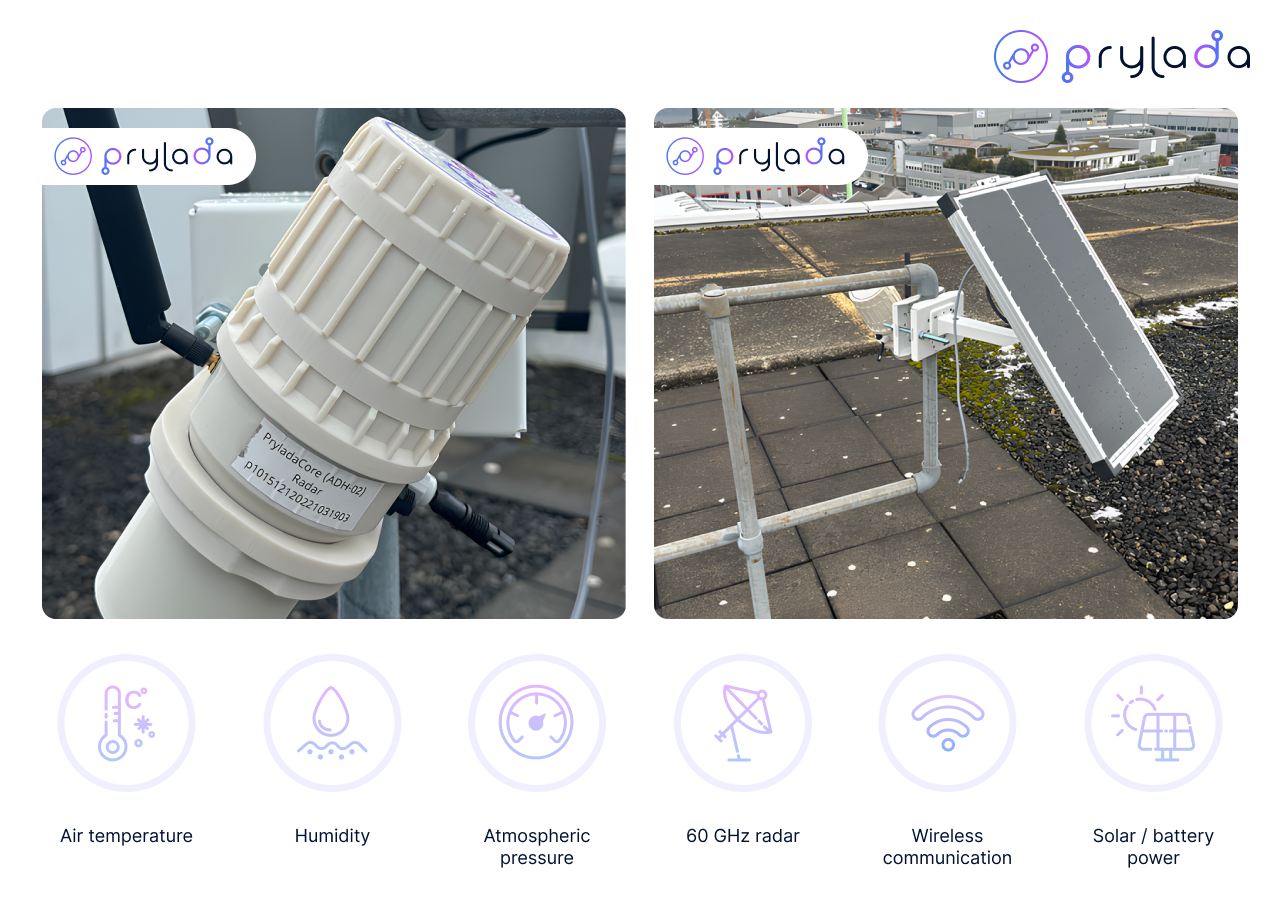
The device can be equipped with several built-in sensors:
- Air temperature sensor for detecting heating and freezing conditions.
- Humidity sensor for monitoring moisture levels around infrastructure and equipment.
- 60 GHz radar for non-contact surface-distance measurements, including snow depth, water accumulation, or structural changes.
- Atmospheric pressure sensor for detecting pressure fluctuations associated with changing weather conditions.
The combination of these sensors makes Environmental Point more than a standalone weather sensor.
It is a foundation for building application-specific monitoring systems in which environmental measurements can be combined with other sensors, analytics, rules, and alerts.
Multi-sensor devices for industrial environmental monitoring
Industrial facilities rarely have a single environmental parameter that determines whether an asset is safe or an operation can continue normally.
For example, temperature alone may not be sufficient to assess the risk of road icing. Snow depth alone does not fully describe the load on a roof. Humidity becomes much more valuable when analyzed together with temperature and other environmental conditions.
This is why multi-sensor devices are useful for industrial monitoring.
Prylada Environmental Point can combine temperature, humidity, atmospheric pressure, and radar measurements at a single monitoring point. Additional Prylada sensors and interfaces can also be incorporated into the wider monitoring architecture.
This allows facility managers to collect the environmental data that is relevant to a particular asset instead of deploying multiple disconnected monitoring systems.
Rugged environmental sensors for remote industrial sites
Industrial monitoring points are often installed outdoors, far from buildings, power infrastructure, or permanent personnel.
Prylada component is designed for continuous operation in outdoor and demanding environments, with energy-efficient operation and solar-powered configurations available. Prylada also uses wireless connectivity to reduce the need for communication cabling between distributed monitoring points.
This makes the platform suitable for applications where rugged environmental sensors and remote monitoring are required, including:
- industrial and construction sites;
- warehouses and logistics facilities;
- roads and highways;
- bridges and tunnels;
- remote infrastructure;
- renewable energy facilities;
- large industrial roofs;
- outdoor equipment areas.
The objective is simple: keep collecting environmental data even when visiting the monitoring point regularly is inconvenient, expensive, or unsafe.
Temperature and humidity monitoring for industrial facilities
Temperature and humidity monitoring is one of the most common requirements for industrial environmental monitoring.
Changes in temperature and moisture can affect industrial equipment, stored materials, infrastructure, and working conditions. Continuous measurements provide facility managers with information that periodic manual inspections cannot provide.
Prylada Environmental Point can continuously monitor ambient temperature and humidity and transfer this data to a centralized monitoring platform.
This enables teams to:
- monitor environmental conditions remotely;
- identify abnormal temperature or humidity changes;
- establish application-specific thresholds;
- receive alerts when conditions require attention;
- analyze historical environmental trends;
- correlate environmental changes with asset behavior.
Instead of asking “What are the conditions right now?”, facility managers can also analyze “How have conditions changed over the last hours, days, or weeks?”
That historical context can be important for preventive maintenance and operational planning.
Wireless weather sensors connected to an industrial monitoring system
Standalone wireless weather sensors can provide useful environmental measurements, but industrial applications often require more than a sensor and a local display.
Prylada takes a system-level approach.
Environmental Point collects the measurements, while the Prylada Gateway provides reliable, low-power, long-range data transmission. The Gateway can transmit data using NB-IoT, LTE-M, or LoRaWAN to cloud-based or on-premises servers.
The resulting architecture is:
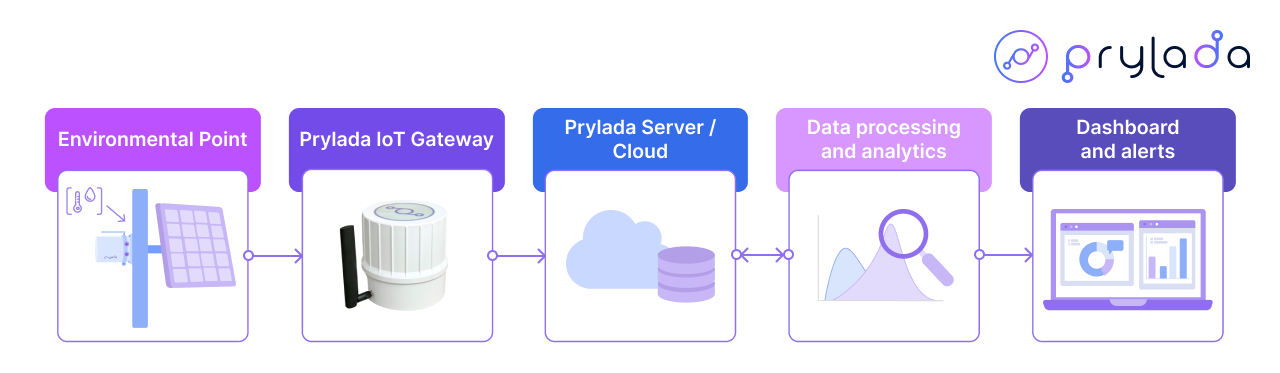
This architecture allows monitoring points to be distributed across large industrial facilities while keeping environmental data accessible from a centralized system.
The Gateway also supports additional industrial interfaces, including 4–20 mA, 0–10 V, digital I/O, RTD, and relay functionality, making the platform suitable for integrating environmental monitoring into broader industrial systems.
From environmental measurements to industrial condition monitoring
Environmental data becomes significantly more valuable when it is connected to the condition of a physical asset.
This is the basis of industrial condition monitoring.
Instead of treating temperature, humidity, snow, or surface conditions as isolated measurements, Prylada can combine environmental data with other sensor information and application-specific logic.
The monitoring workflow can include:
Measure → Transfer → Analyze → Alert → Act
Environmental Point provides the measurement layer.
The Gateway transfers data.
Prylada Server or Cloud provides centralized storage, visualization, and analytics.
Rules, thresholds, and application-specific models help identify potentially important conditions.
Alerts then provide facility teams with information they can use to decide whether an intervention is required.
This approach transforms environmental monitoring from passive data collection into an operational tool.
Environmental monitoring in real-world industrial applications
The flexibility of Environmental Point becomes particularly clear when looking at specific Prylada applications.
Two examples are remote snow load monitoring and black ice warning and detection.
Both involve environmental conditions, but the monitoring objectives are completely different.
Remote Snow Load Monitoring
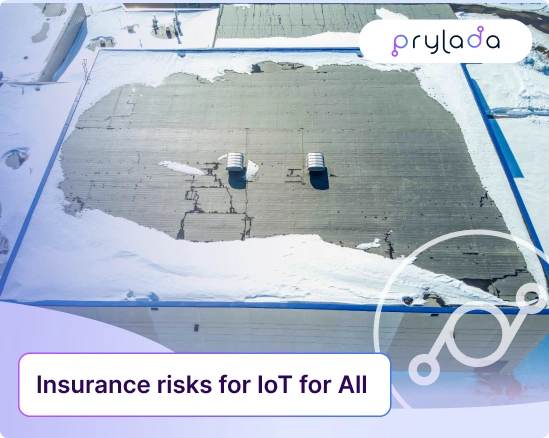
Snow accumulation can become a serious operational and structural risk for large industrial roofs, warehouses, distribution centers, manufacturing facilities, and other buildings with large-area flat or low-slope roofs.
Manual inspections provide only occasional information and may require personnel to access the roof during hazardous winter conditions.
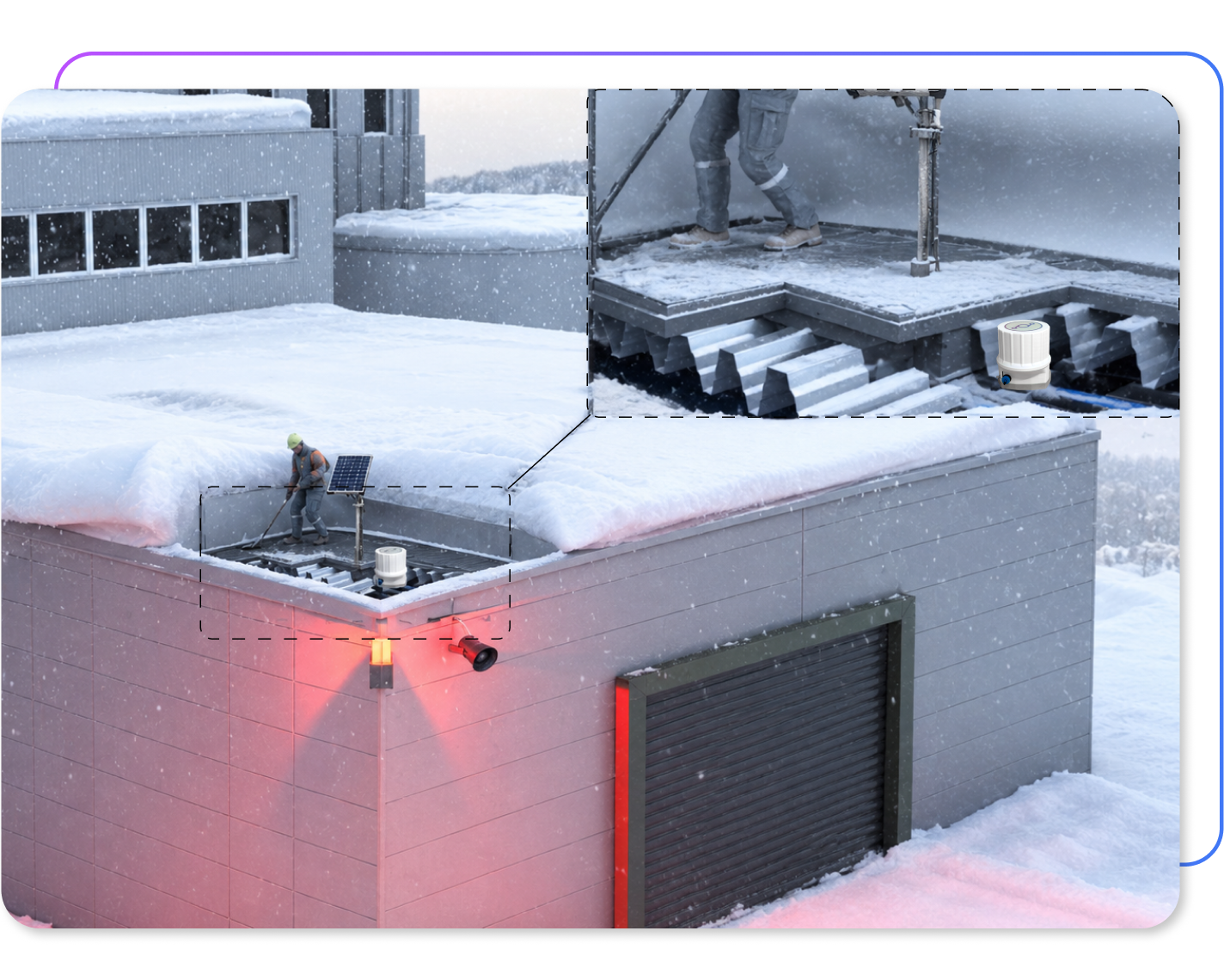
Prylada's Remote Flat Roof Snow Load Monitoring Solution provides continuous monitoring of snow accumulation, roof conditions, and structural changes.
Measuring both snow accumulation and structural response
Prylada uses two complementary measurement approaches.
Inclinometers are installed at key structural support points and measure angular displacement, showing how the roof structure responds to changing loads.
Radar sensors measure snow cover height across selected roof areas, providing information about snow accumulation.
These measurements answer two different questions:
What is accumulating on the roof?
and
How is the structure responding?
When used together, snow depth and structural response provide a more complete picture of changing roof conditions.
Importantly, Prylada does not directly identify or classify the type of snow. Instead, the system uses measurements such as snow depth and roof deflection to assess changing conditions and provide additional context for evaluating snow-related risks.
Environmental data adds another layer of context
Temperature and other environmental measurements can also be analyzed alongside snow and structural data.
Prylada's snow monitoring architecture uses machine-learning analytics to analyze sensor patterns and correlations, helping identify normal and critical snow load states based on available measurements and environmental patterns.
The system can also dynamically adjust measurement frequency. Under normal conditions, monitoring can operate at a lower frequency to reduce energy consumption. When predefined thresholds are exceeded, the system can switch to higher-frequency monitoring to capture changes in greater detail.
For facility managers, this means that the monitoring system can focus resources on periods when the risk is increasing.
Environmental Point therefore becomes part of a larger roof monitoring solution rather than simply a weather sensor.
[Explore Remote Snow Load Monitoring →]
Black Ice Warning and Detection
Black ice is another example of why environmental monitoring needs to combine several measurements rather than relying on a single sensor.
A road surface can become icy when conditions approach freezing, even when the formation of ice is difficult to identify visually.
Prylada's Black Ice Warning and Detection Solution combines environmental and surface measurements to identify conditions associated with black ice formation.
The monitoring approach can use:
- air temperature;
- surface temperature;
- humidity;
- 60 GHz radar;
- historical sensor data;
- application-specific analytical models.
The combination provides a more complete picture of what is happening at the monitored road surface.
Why multiple measurements matter
A temperature reading alone does not explain the complete road condition.
For example, the system can evaluate temperature together with humidity and surface-related measurements to identify changes that may indicate increasing icing risk.
This is where multi-sensor devices and application-specific analytics become valuable: the system can correlate several environmental parameters rather than generating an alert based on one measurement in isolation.
Dynamic environmental monitoring
The monitoring system can also adjust measurement frequency according to changing conditions.
During stable conditions, lower-frequency monitoring can reduce unnecessary energy consumption.
When predefined risk conditions are detected, the system can increase the frequency of measurements to provide more detailed information during the critical period.
This creates a monitoring system that is not only wireless and remote, but also adaptive to changing environmental conditions.
[Explore Black Ice Warning and Detection →]
Cloud-connected monitoring systems for industrial facilities
Collecting sensor data is only useful if facility teams can access and act on it.
Prylada provides cloud-connected monitoring systems in which environmental measurements are transferred from distributed monitoring points to a centralized platform.
The Prylada Environmental Point page demonstrates the complete monitoring workflow: sensors collect environmental data, the system processes the measurements, and the data is transmitted to a cloud-based control center for analysis and visualization.
Prylada Cloud can store, analyze, and visualize collected data and support remote management of connected gateways. Alternatively, organizations can use private-cloud or local-server deployments when required by their infrastructure or security policies.
This enables facility managers to monitor multiple locations from a single system.
Instead of checking individual sensors, teams can access:
- current environmental conditions;
- historical measurements;
- device status;
- trends and changes;
- configured alerts;
- monitoring data from multiple locations.
The result is centralized visibility across distributed industrial assets.
One Environmental Point, multiple monitoring applications
One of the main advantages of the Prylada architecture is that Environmental Point is not limited to one specific monitoring scenario.
The same hardware foundation can support different applications depending on the environmental parameters, additional sensors, data processing logic, and business rules required.
Examples include:
Industrial environmental monitoring
Monitor temperature, humidity, atmospheric pressure, and other environmental conditions around industrial facilities and remote assets.
Snow load monitoring
Combine radar-based snow measurements, structural inclinometers, and environmental data to monitor roof conditions.
Black ice detection
Combine temperature, humidity, surface measurements, radar, and analytics to identify conditions associated with road icing.
Infrastructure monitoring
Monitor environmental conditions around bridges, tunnels, roads, and other critical infrastructure.
Renewable energy facilities
Collect local weather and environmental data around solar and wind installations.
Construction sites
Monitor changing environmental conditions at temporary or distributed construction locations.
This flexibility allows companies to start with a specific monitoring problem and expand the same IoT infrastructure to additional applications over time.
A complete industrial environmental monitoring architecture
Prylada Environmental Point is one component of a broader monitoring ecosystem.
A typical deployment consists of:
1. Environmental Point
Collects environmental measurements using embedded sensors such as temperature, humidity, atmospheric pressure, and 60 GHz radar.
2. Wireless Gateway
Transfers data from monitoring points using NB-IoT, LTE-M, or LoRaWAN.
3. Prylada Server or Cloud
Stores and processes measurements and provides centralized access to monitoring data.
4. Analytics
Applies thresholds, rules, correlations, and application-specific analytical models.
5. Dashboard
Provides facility managers with current and historical monitoring data.
6. Alerts
Notifies responsible teams when configured environmental or asset-related conditions require attention.
7. Action
Enables maintenance and operations teams to respond based on actual monitoring data rather than assumptions or periodic inspections.
This is what turns industrial environmental monitoring devices into a complete industrial monitoring solution.
From environmental data to better decisions
For industrial asset owners and facility managers, environmental monitoring is ultimately about making better operational decisions.
Is a roof accumulating a dangerous amount of snow?
Is a road surface approaching conditions where black ice may form?
Are temperature and humidity conditions changing around critical equipment?
Is an environmental event developing that requires maintenance or intervention?
Prylada Environmental Point provides the hardware foundation for answering these questions with continuous, remotely accessible data.
By combining industrial environmental monitoring devices, rugged environmental sensors, temperature and humidity monitoring, wireless weather sensors, industrial condition monitoring, cloud-connected monitoring systems, and multi-sensor devices within one IoT architecture, Prylada enables organizations to move from periodic inspection toward continuous, data-driven monitoring.
From remote snow load monitoring on industrial roofs to black ice detection on roads, the same Environmental Point platform can be configured around the environmental risks that matter to each facility.

.webp)