
.svg)
Prylada Ice Detection Point – Road surface ice monitoring
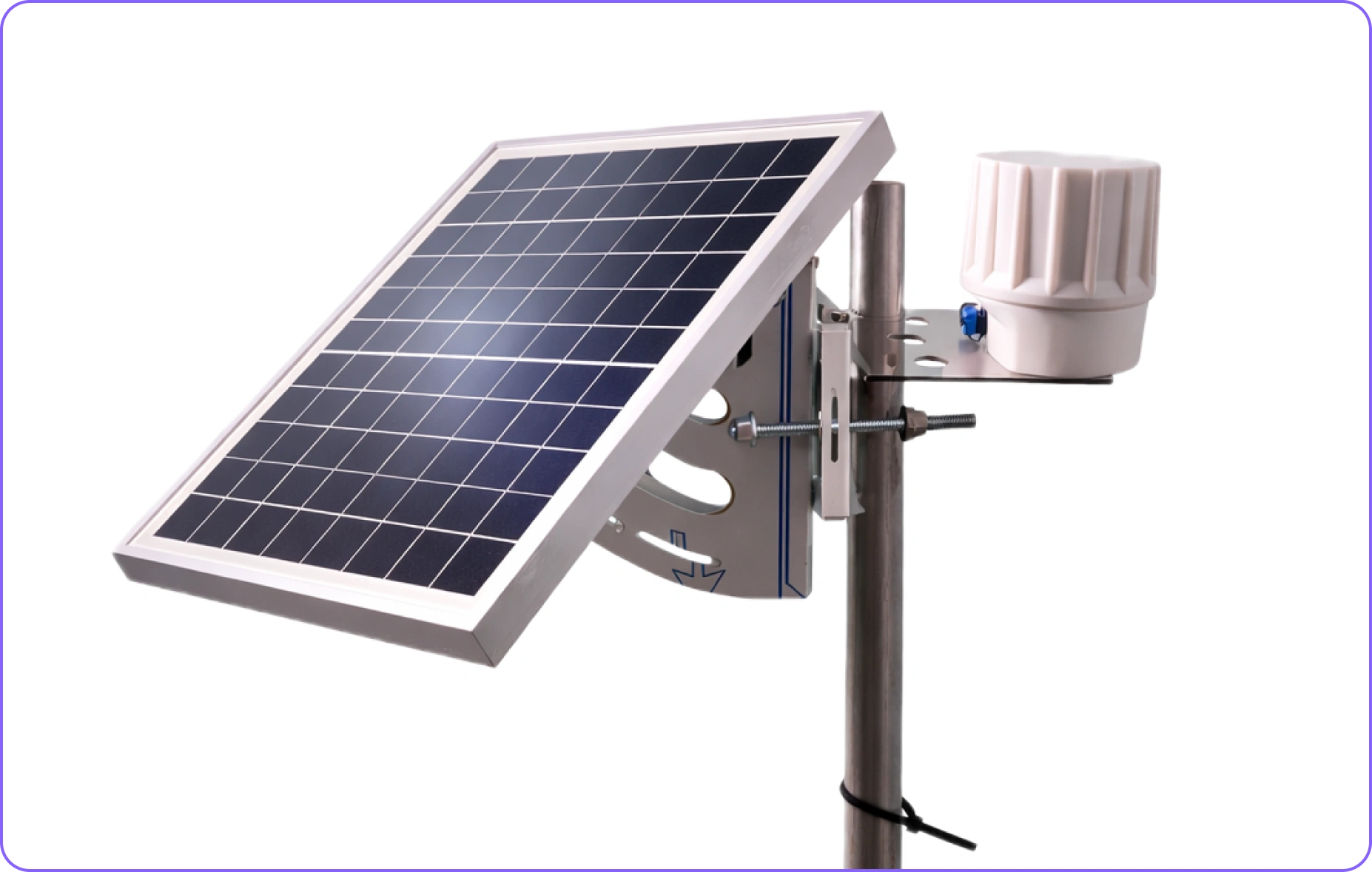
Prylada Ice Detection Point is a self-sufficient roadside installation designed for continuous monitoring of road surface conditions and early detection of icing risks. The component collects, processes, and transmits real-time data to support operational decision-making for road operators and winter maintenance services.
Available as Hardware as a Service (HaaS)
To get started, simply choose the device configuration (with or without solar panel), select the contract duration, and pay a fixed monthly fee - no upfront hardware investment required.


View live demo dashboard
The Ice Detection Point dashboard provides real-time visibility into road surface conditions using threshold-based evaluation logic. The interface displays current environmental parameters, rule activation status, and active alarms, allowing operators to quickly assess icing risks and respond to hazardous conditions.
Data visualization and system deployment
The dashboard visualizes all collected data and can be deployed on Prylada Cloud, private cloud, or your local server.Real-time monitoring, historical analysis, alarm tracking, and API access for seamless integration with your existing systems.
The same dashboard you see in the demo is available as part of the Hardware as a Service subscription. Once the Ice Detection Point is deployed, data is immediately available in your dashboards, no additional setup required.
Key elements of the Prylada Ice Detection Point
Prylada Ice Detection Point is a compound system that integrates multiple sensors, an IoT gateway, and an autonomous power supply into a single monitoring point. The device performs on-site data collection and preliminary processing before securely transmitting data to a central analytics platform.
The Ice Detection Point is equipped with the following sensors and hardware components:

Monitors ambient temperature to identify freezing conditions affecting road surfaces.

Tracks moisture levels near the road surface for accurate ice risk assessment.

Measures surface-level temperature to detect conditions critical for ice formation.

Ensure reliable and uninterrupted operation of all sensors.

A high-precision, non-contact pulsed coherent radar (PCR) is used to measure surface distance and detect the presence of water, ice layers, or changes in surface state.

Provides sustainable, energy-efficient power, enabling long-term autonomous operation in remote or roadside locations
The Ice Detection Point is delivered as a ready-to-deploy unit and is available via a Hardware as a Service model, allowing customers to choose configuration and contract duration with a fixed monthly fee.
The Prylada NB-IoT Gateway is the core communication module of the Ice Detection Point.
It delivers reliable, low-power connectivity from any roadside location to the analytics platform, using NB-IoT and LTE-M networks. Secure data transmission, minimal energy consumption, and weatherproof design ensure continuous operation without constant maintenance.
Built for the conditions where monitoring matters most.


Ask for the gateway specifications
Leave us your email, and we will reach out to you to provide with all the necessary information
Ordering and deployment model
Prylada Ice Detection Point can be deployed using a flexible Hardware as a Service (HaaS) model. This approach allows you to start monitoring road surface conditions without purchasing hardware upfront.
How it works
- Solar panel
- Grid-powered
- Short-term pilot
- Long-term deployment
Covering hardware, connectivity, and platform access
The HaaS model reduces deployment time, simplifies budgeting, and enables rapid scaling of ice monitoring points across your road network.

ML-based data processing and analysis
A key element of the Prylada Ice Detection Point is machine learning–based data processing. Sensor data streams are analyzed using ML models trained on road surface conditions to:
• Correlate air temperature, surface temperature, humidity, and radar measurements
• Detect subtle patterns indicating early-stage ice formation
• Reduce false alarms caused by short-term or isolated threshold crossings
• Continuously improve detection accuracy based on historical data
ML processing is applied as part of the data analysis pipeline, enabling predictive insights and more reliable ice warnings compared to rule-based systems alone.
Click to see the full-size version

.webp)
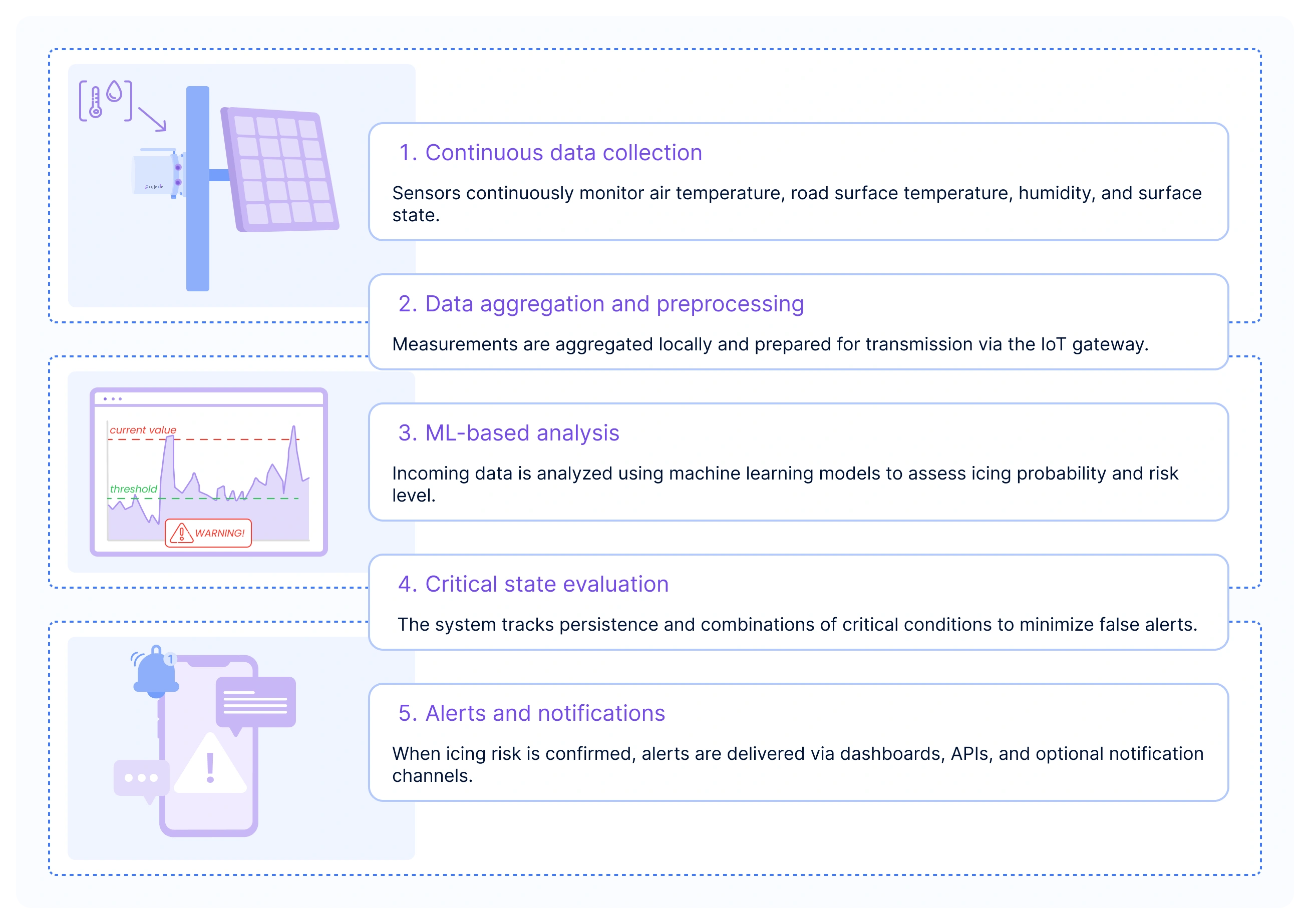
How Prylada Ice Detection Point works in real time
.webp)
Competitive advantages of Prylada Ice Detection Point

Precise road surface ice detection using multi-sensor fusion

ML-based analytics for higher accuracy and fewer false alarms

Autonomous, solar-powered operation for remote roadside deployment

Reliable NB-IoT connectivity in low-coverage areas

Flexible deployment: cloud, private cloud, or on-premise

Seamless integration with road maintenance and traffic management systems
Use cases and applications
Black ice poses critical safety risks across multiple sectors. Prylada's Ice Detection Point helps organizations prevent accidents and maintain safe operations in winter conditions:
Protect cargo schedules and driver safety by identifying hazardous road conditions before they cause delays or accidents.
Keep buses and trains running safely in freeze-thaw zones where ice forms unpredictably on routes and platforms.
Reduce driver incidents and liability exposure with real-time alerts about icy road segments.
Deploy de-icing resources where they're needed most, based on actual road conditions, not forecasts.
Enable first responders to choose safer routes and maintain response times even during ice events.
Detect ice formation on runways, taxiways, and access roads critical for airport operations.
Monitor elevated structures that freeze first and stay icy longest before conditions become dangerous.
Protect pedestrians and cyclists by tracking ice on sidewalks, bike lanes, and high-traffic crosswalks.
Optimize delivery routes and driver assignments based on real-time ice conditions across your operating area.
Prevent slip-and-fall incidents in parking lots, driveways, and customer access points at commercial properties.
Maintain service continuity by monitoring ice conditions affecting equipment access and field operations.
Assess exposure more accurately, provide policyholders with proactive safety alerts, and reduce winter-related claims.