.svg)



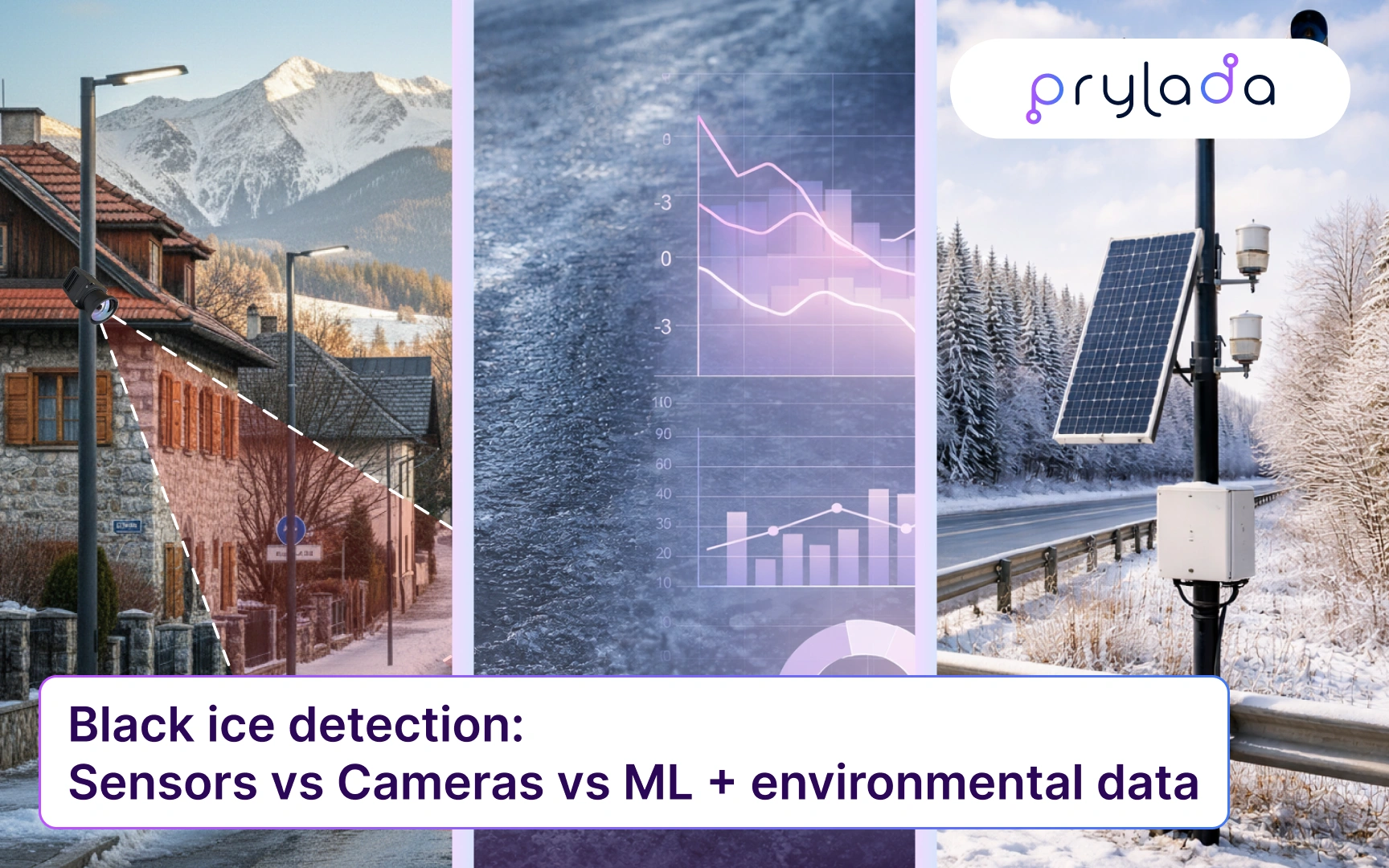
How to choose a cost-effective black ice warning system for roads, parking lots, and critical infrastructure.
Black ice is one of the most dangerous winter hazards because it’s nearly invisible, forms quickly, and can appear even when general forecasts don’t look alarming. For municipalities, road operators, parking facility owners, logistics hubs, and industrial sites, the key challenge is not only “detecting ice,” but warning early enough to act.
Today, the market offers multiple black ice detection technologies, including road-surface sensors, infrared or optical camera systems, and data-driven approaches using machine learning (ML) and environmental monitoring data.
In this article, we compare the most common options and explain why Prylada’s ML + environmental data approach can deliver actionable black ice warnings at a lower total cost than many infrared/laser-based systems.
What is black ice, and why is it hard to detect?
Black ice is a thin, transparent layer of ice that forms on asphalt or concrete. It is difficult to see, especially at night, in low light, or on dark pavement.
Black ice often forms under conditions like:
- surface temperature near or below 0°C (32°F)
- high humidity or moisture present
- freezing fog, freezing rain, or light precipitation
- refreezing after daytime melting
- microclimates (bridges, ramps, shaded parking zones, exposed areas)
Because the phenomenon is highly local, weather forecasts alone are not enough; operators need site-level monitoring and alerts that reflect real surface risk.
Black ice detection technology overview
Most solutions fall into three categories:
- Road weather stations (RWIS) and road surface condition sensors
- Infrared cameras, laser systems, and optical detection
- ML + environmental data monitoring (Prylada approach)
Let’s compare them.
Option 1: Road weather stations and road surface sensors (RWIS)
.webp)
RWIS solutions and road surface condition sensors measure environmental and surface variables such as:
- air temperature
- humidity
- dew point
- precipitation type/intensity
- road surface temperature
- freezing risk indicators
These systems are widely used in transportation infrastructure.
Option 2: Infrared cameras, laser-based, and optical black ice detection
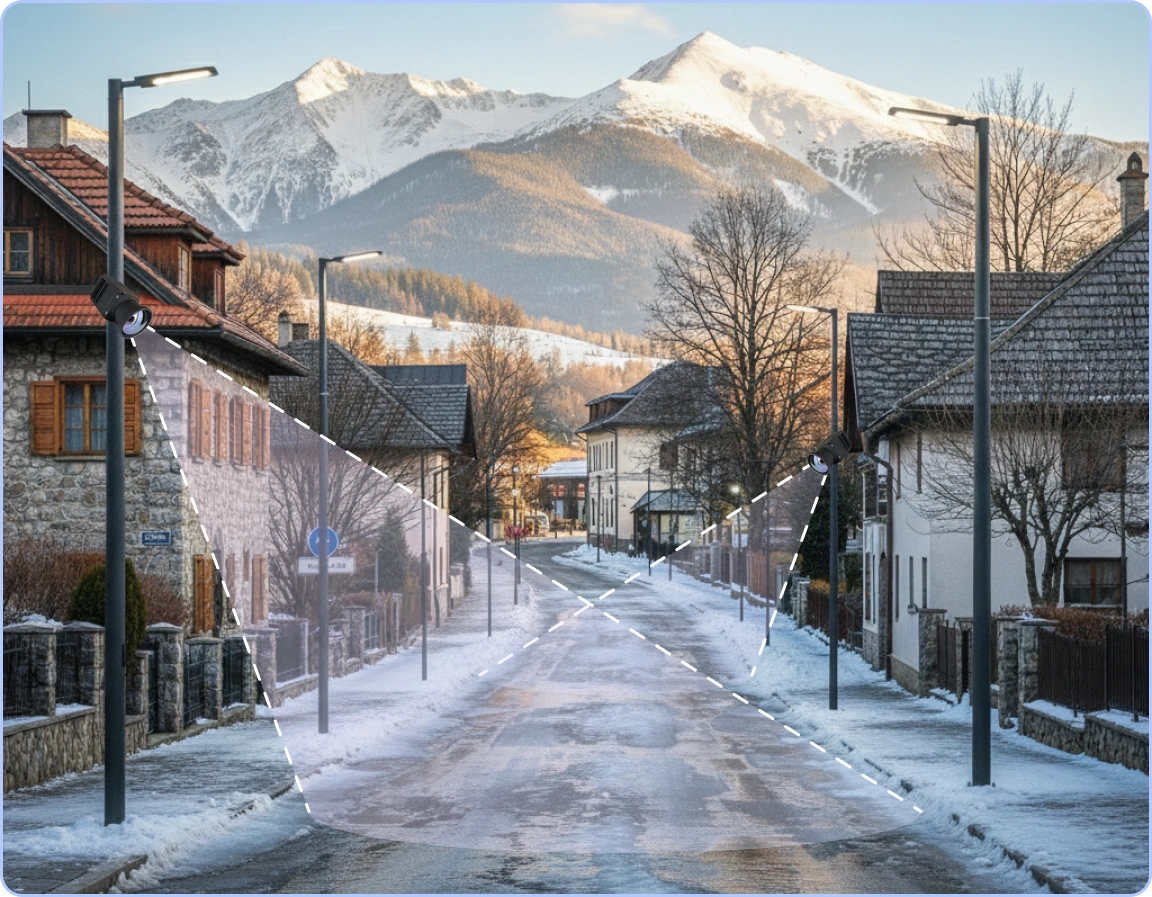
Some black ice detection systems use:
- infrared thermography
- laser reflection
- optical/multispectral analysis
These methods attempt to detect surface conditions by analyzing radiation or reflection patterns
Option 3: ML + environmental data (Prylada)
.webp)
Prylada approaches black ice detection differently: instead of relying only on expensive “direct ice measurement” hardware, it uses environmental monitoring data and machine learning to detect patterns that typically lead to black ice formation.
Prylada’s black ice warning and detection solution combines:
- environmental monitoring (temperature, humidity, etc.)
- continuous data collection
- intelligent analytics and ML inference
- scalable connectivity and multi-site deployment logic
The goal is operational:
Why ML + environmental monitoring works
Black ice formation is rarely random. It often happens when multiple variables align, for example:
- rapid temperature drop + moisture presence
- high humidity + near-freezing surface temperature
- refreezing after melting cycles
Instead of using only basic thresholds, ML models can learn combinations and transitions that signal risk earlier.

Comparison table: black ice sensors vs cameras vs ML
How leading market solutions compare (neutral overview)
Vaisala
Vaisala is widely recognized for RWIS and weather monitoring technologies used by transportation and infrastructure operators. Their solutions are often designed for large-scale road networks and long-term monitoring programs.
Typical strengths:
- mature RWIS ecosystem
- strong instrumentation and data reliability
- proven in harsh environments
Typical considerations:
- higher cost per location
- scaling to many smaller sites can be expensive
KELAG (GFS via IoT)
KELAG’s “GFS via IoT” approach is positioned around connected infrastructure and IoT-enabled weather/road-related monitoring. It supports the idea of using distributed sensing + connectivity for operational decision-making.
Typical strengths:
- IoT connectivity and integration mindset
- supports scalable data distribution
Typical considerations:
- end-to-end performance depends on the sensor stack and configuration
- may still require substantial infrastructure, depending on the deployment model
Campbell Scientific
Campbell Scientific is known for environmental monitoring systems used in research and industrial deployments. In road monitoring, this often translates to robust sensing and data logging solutions suitable for harsh conditions.
Typical strengths:
- high-quality measurement systems
- reliable hardware for demanding environments
Typical considerations:
- can become costly at scale
- system design and integration may require engineering effort
Thies Clima
Thies Clima provides meteorological and precipitation measurement devices, which can be part of weather monitoring setups supporting winter operations.
Typical strengths:
- strong meteorological measurement portfolio
- useful for precipitation-related monitoring
Typical considerations:
- may require additional layers (analytics/ML/workflows) to convert data into black ice warnings
Why operators choose Prylada for black ice monitoring
1. Lower total cost of ownership (TCO)
Infrared cameras, laser systems, and premium RWIS installations often come with high costs beyond the device itself:
- installation work
- maintenance and servicing
- replacement cycles
- integration and connectivity costs
Prylada is designed to reduce operational complexity and cost per site.
2. Scales across parking lots and local roads
Black ice risk is often highest in distributed environments:
- parking lots and ramps
- bridges and shaded road sections
- logistics yards
- industrial campuses
Prylada supports multi-site monitoring without requiring premium hardware at every location.
3. Actionable alerts, not just raw measurements
Many organizations don’t need scientific-grade measurement—they need:
- early warnings
- fewer false alarms
- clear operational triggers
Prylada focuses on producing alerts that support winter maintenance workflows.
Conclusion: Which black ice detection approach should you choose?
If your priority is direct measurement and you have a large infrastructure budget, RWIS and dedicated sensors can be a strong fit. If you need premium monitoring at a small number of critical points, optical/infrared solutions may work.
But if your goal is to deploy black ice monitoring across many locations with a cost-efficient, scalable approach, ML + environmental monitoring can provide the best balance of accuracy and practicality.
Prylada enables reliable black ice warnings without expensive infrared or laser-heavy hardware, making it a strong option for parking operators, municipalities, logistics sites, and industrial facilities.